


Immigration News
Investment Immigration Expected to Attract HKD 95 Billion as Middle East Demand Rises
Posted by Uni Immigration on 2026-03-04
Investment Immigration Expected to Attract HKD 95 Billion as Middle East Demand Rises
Two years after launch, 1,762 applications were approved
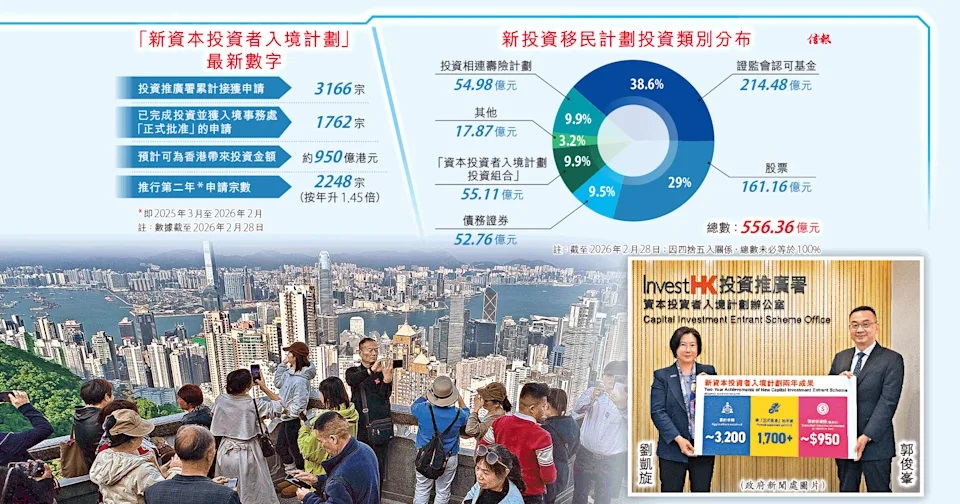
The "New Capital Investor Entry Scheme", commonly known as the new investment immigration program, has been launched for two years. As of the end of February, a total of 3,166 applications have been received, of which 1,762 have completed investment and been officially approved by the Immigration Department. It is expected to bring about 95 billion yuan in investment to Hong Kong.
Recently, a war has broken out in the Middle East. Comprehensive immigration consultants have analyzed that there are many high-net-worth individuals living there. They focus most on capital and personal safety, and hope to obtain multiple identities to spread risks. It is believed that investment immigration applications in Hong Kong are increasing. In the second year of implementation of the new program (i.e., from March 2025 to February 2026), 2,248 applications were received, a 1.45 times increase from the first year. Zheng Tianyin, senior strategy director of Midland Immigration Consultants, said that in the first year, customers generally wait and see. In the second year, when friends around the customers continue to be successfully approved, their application confidence increases; and the Hong Kong government continues to optimize plans and lower the threshold. It is currently observed that 80% to 90% of applicants are mainlanders and apply for Hong Kong investment immigration through third country status.
The situation in the Middle East has been unstable recently, and immigration consultants have also received related inquiries. Zheng Tianyin said that some clients are investing in real estate in Middle East regions such as Dubai. Geopolitical risks have increased sharply in recent days. They hope to find a safer and politically stable place and study transferring funds from Middle East regions such as Dubai or external funds to Hong Kong. In addition to mainland customers, customers from Southeast Asia or the United States also have related inquiries.
Unrest in the Gulf region expects inquiries about Hong Kong to rise
Liu Biqi, business development director of Uni Immigration Consulting, pointed out that Dubai has a property purchase visa. Foreigners only need to purchase a property equivalent to about HK$2.1 million or more in Dubai to apply for a three-year residence visa, attracting many people to move to the city. Although Dubai's tax rate is low, recent events have shown that conflicts in neighboring countries will also be involved, and "cannonballs will fly over during a war." Anticipating more inquiries from wealthy people in the Middle East in the future, the company's website is adding an Arabic version to cope with demand. Liu Biqi said frankly, "The situation is unstable. For wealthy people, having multiple identities, no matter where they are, if sanctions or other things happen, they have one more option to diversify risks." She said that some Shanghai clients even have 5 to 6 identities.
Nearly 40% buy funds, stocks account for 29%
In terms of investment preferences, among the applications that have been verified to be in compliance with investment regulations, the most investments were in funds, reaching 21.448 billion yuan, accounting for 38.6% of the total investment, a slight increase from 36.4% at the end of April last year; investment in stocks reached 16.116 billion yuan, accounting for 29%, higher than 28.1% at the end of April last year.
Liu Biqi said that most of the customers invest in funds. The investment scope of the China Securities Regulatory Commission-qualified funds is wider than the old plan. You can buy assets in mature areas such as the United States, assets in emerging areas such as India, and even Bitcoin funds, or low-risk currency funds. There are many types. In addition, the investment time is longer than 7 years, and the risk of a single stock is relatively high. After the stock is sold, all the proceeds must be reinvested within 14 days. Additional fees, brokerage commissions, stamp duties, etc. also need to be paid, making frequent transactions inconvenient, so funds are more suitable.
As for other assets including real estate, it was 1.787 billion yuan, accounting for only 3.2%. A single residential property with a current transaction price of 30 million yuan can be counted as an investment of 10 million yuan, and an industrial and commercial shop can be counted as 15 million yuan. Zheng Tianyin said that when customers purchase units worth more than 30 million yuan, they are referred by real estate colleagues and apply for investment immigration, accounting for about 20 to 30% of the cases. Mainly buying residential properties, due to actual housing demand or high rental returns, while the office and industrial and commercial markets are relatively quiet.
As for how the plan can be further optimized, Zheng Tianyin hopes that the residence requirements for Hong Kong permanent residents can be clarified. Currently, it only lists "ordinarily resides in Hong Kong" without specifying the number of days of residence. According to experience, if you have spent half of your time in Hong Kong in the past seven years and have a residence and income in Hong Kong, the Immigration Department will approve it, but there are signs of tightening recently. Although under the new scheme, those who do not ordinarily reside in Hong Kong can also obtain "unconditional residence", many customers hope to obtain a SAR passport. In addition, it is difficult to transfer funds from the mainland to Hong Kong. If a special foreign exchange channel can be established for property purchase, I believe it will attract more people to apply.
* 資料來源:yahoo財經
* Original link (click here)